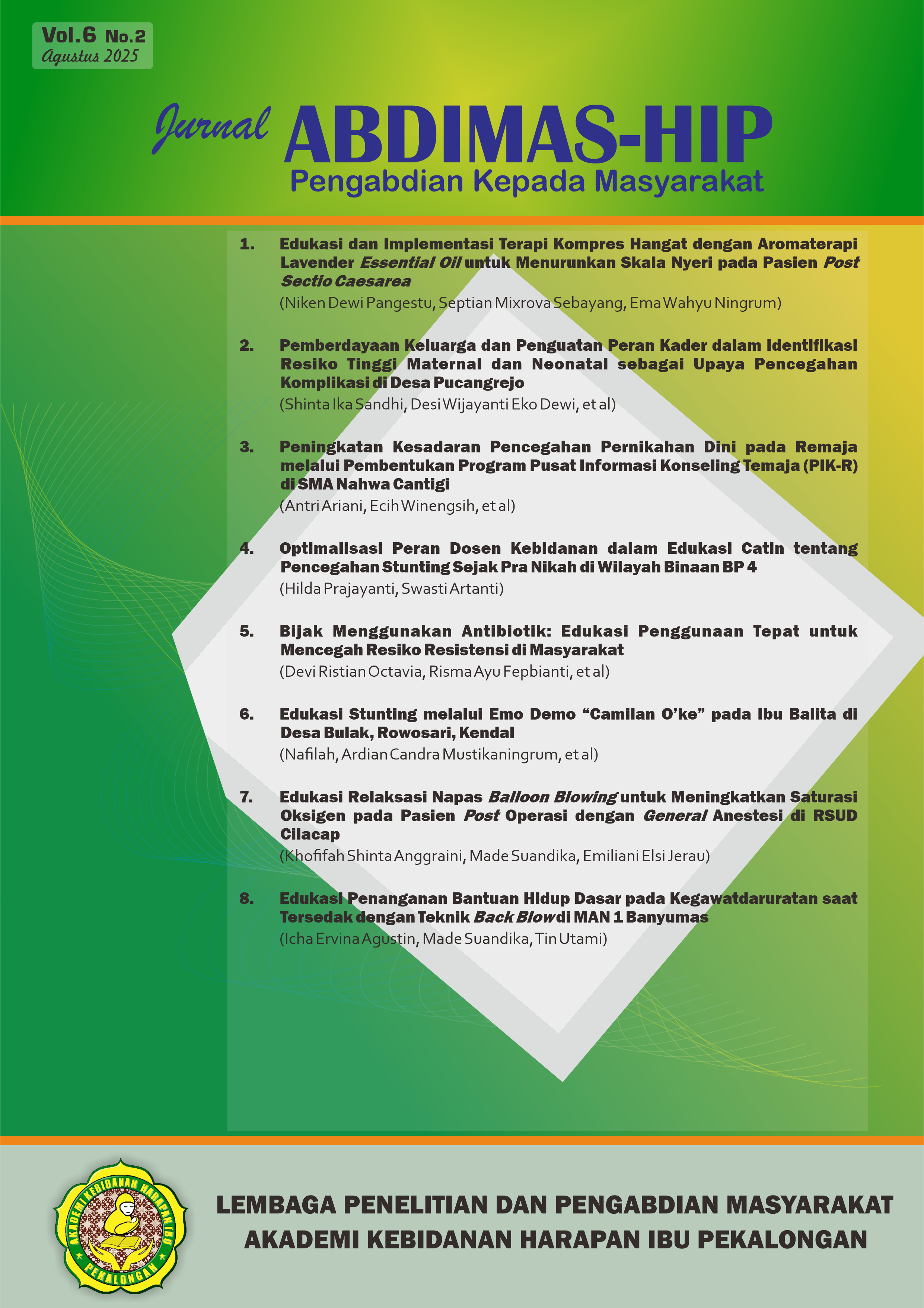
Peningkatan Kesadaran Pencegahan Pernikahan Dini pada Remaja melalui Pembentukan Program Pusat Informasi Konseling Temaja (PIK-R) di SMA Nahwa Cantigi
DOI:
https://doi.org/10.37402/abdimaship.vol6.iss2.485Keywords:
adolescent, early marriage, PIK-RAbstract
Marriage at a young age can have a negative impact on health, both physically and psychologically. Perception is one of the factors that influence adolescents' decisions towards early marriage. Adolescents' perception of early marriage is greatly influenced by three main aspects, namely cognitive, affective, and conative. In Indonesia, early marriage has reached alarming levels. Based on UNICEF data as of the end of 2022, Indonesia is currently ranked 4th in the world and 2nd in ASEAN, with a total of nearly 1.5 million cases. The method used in this activity is the provision of education through counseling with video communication media, leaflets and the provision of materials. Participants totaled 65 students of Nahwa Cantigi High School. Participants were given a questionnaire after providing educational materials, the results were obtained that more than half of the adolescents had good cognitive aspects (73.8%), and more than half of the adolescents (54%) did not support early marriage. And in the conative aspect, adolescents have a good or disagree perception of early marriage as much as (63%). Based on cognitive, affective and conative aspects, more than half of adolescents are well informed, do not support early marriage and are not ready to face these conditions. From the results of this community service, it is hoped that health workers in the region can consistently provide information and counseling to students related to early marriage. And the establishment of a youth counseling information center (PIK-R) program can continue in the future.
Downloads
Published
Issue
Section
License
Authors who publish with this journal agree to the following terms:
-
Authors retain copyright and grant the journal right of first publication with the work simultaneously licensed under a Creative Commons Attribution 4.0 International License (CC BY 4.0) that allows others to share (copy and redistribute the material in any medium or format) and adapt (remix, transform, and build upon the material) for any purpose, even commercially, with an acknowledgement of the work's authorship and initial publication in this journal.
-
Authors are able to enter into separate, additional contractual arrangements for the non-exclusive distribution of the journal's published version of the work (e.g., post it to an institutional repository or publish it in a book), with an acknowledgement of its initial publication in this journal.
-
Authors are permitted and encouraged to post their work online (e.g., in institutional repositories or on their website) prior to and during the submission process, as it can lead to productive exchanges, as well as earlier and greater citation of published work (See The Effect of Open Access).