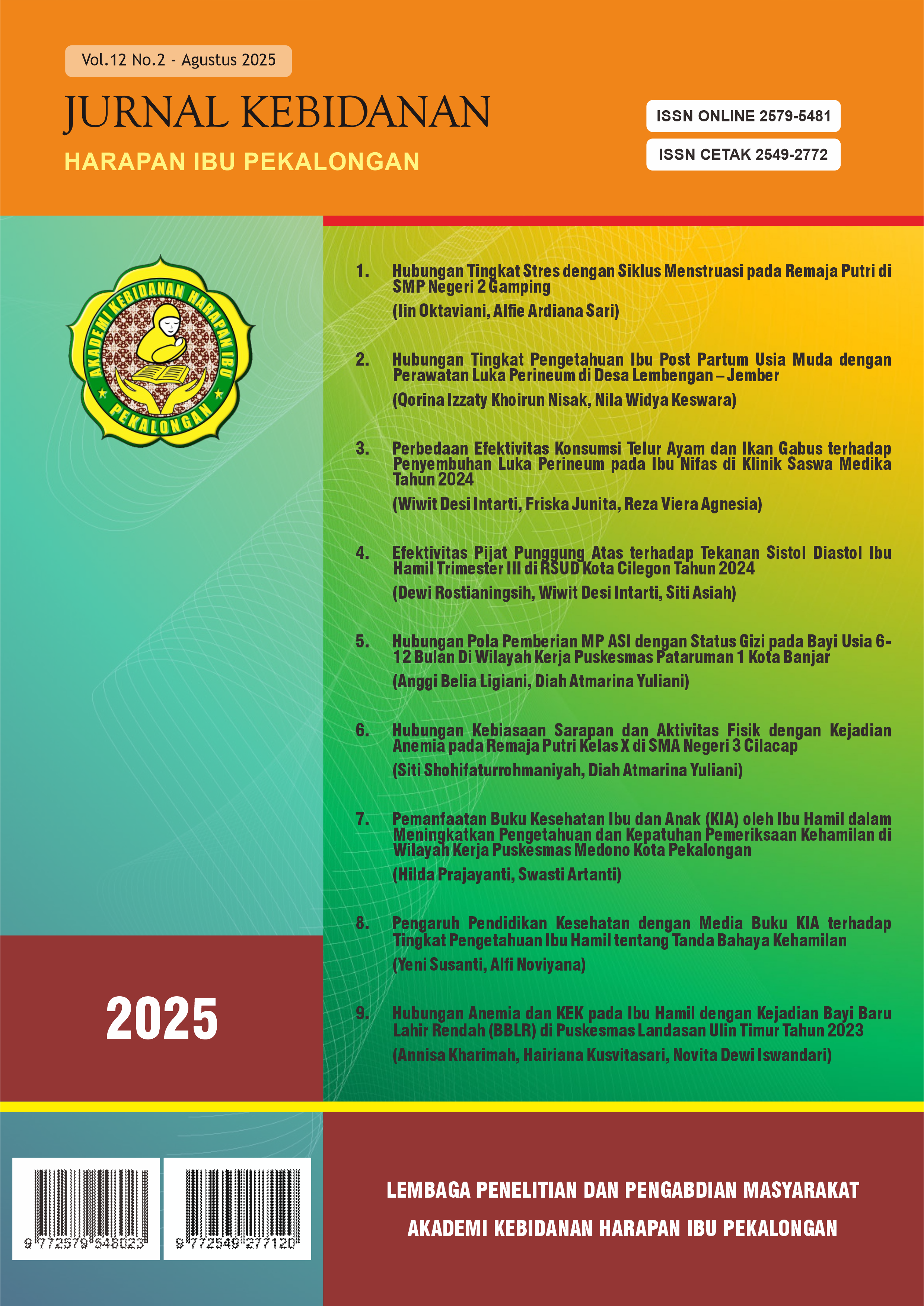
Hubungan Tingkat Stres dengan Siklus Menstruasi pada Remaja Putri di SMP Negeri 2 Gamping
DOI:
https://doi.org/10.37402/jurbidhip.vol12.iss2.454Abstract
Adolescence is a transitional phase that is prone to stress due to physical, psychological, and social changes. Excessive stress can disrupt the balance of reproductive hormones, thus triggering irregular menstrual cycles. In Indonesia, 13.7% of women aged 10-59 years experience irregular menstrual cycles, and in D.I Yogyakarta it reaches 15.8%. The purpose of this study was to determine the relationship between stress levels and menstrual cycles in female adolescents at SMP Negeri 2 Gamping. This research method uses a quantitative approach with a cross-sectional design. The population of this study was 60 female students of SMPN 2 Gamping with a sample size of 52 female students selected using the proportionate stratified random sampling technique. Data collection was carried out using the Perceived Stress Scale (PSS-10) questionnaire to assess stress levels and questionnaires regarding the menstrual cycle. Data were analyzed univariately and bivariately using the Chi-Square test. The results showed that most respondents with moderate stress were 20 people (38.5%) and experienced irregular menstrual cycles. The results of statistical tests show a significant relationship between stress levels and menstrual cycles p = (0.001). It is concluded that there is a relationship between stress levels and menstrual cycles in female adolescents at SMP Negeri 2 Gamping.
Downloads
Published
How to Cite
Issue
Section
License
Authors who publish with this journal agree to the following terms:
Authors retain copyright and grant the journal right of first publication with the work simultaneously licensed under a Creative Commons Attribution License that allows others to share the work with an acknowledgement of the work's authorship and initial publication in this journal.
Authors are able to enter into separate, additional contractual arrangements for the non-exclusive distribution of the journal's published version of the work (e.g., post it to an institutional repository or publish it in a book), with an acknowledgement of its initial publication in this journal.
Authors are permitted and encouraged to post their work online (e.g., in institutional repositories or on their website) prior to and during the submission process, as it can lead to productive exchanges, as well as earlier and greater citation of published work (See The Effect of Open Access).