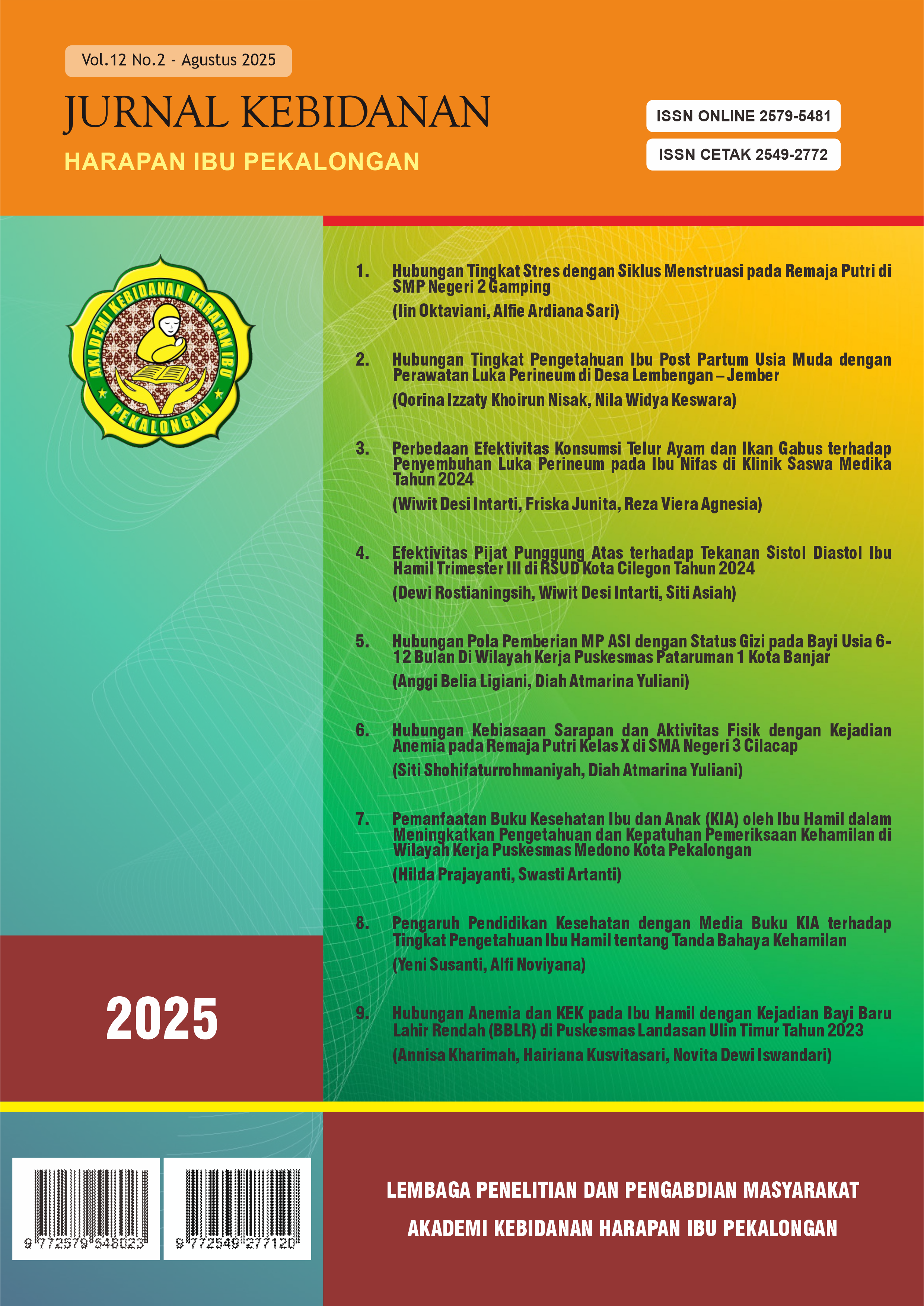
Hubungan Tingkat Pengetahuan Ibu Post Partum Usia Muda dengan Perawatan Luka Perineum di Desa Lembengan – Jember
DOI:
https://doi.org/10.37402/jurbidhip.vol12.iss2.459Keywords:
perineal wound, postpartum mothers, knowledge levelAbstract
Because it is prone to a number of issues, including postpartum infection, the postpartum period is an important time. Wounds in the birth canal, which provide the perfect environment for bacteria to flourish, may be the source of this infection. Further difficulties could arise if an infection in the perineal area spreads to the birth canal or urinary system. Perineal wound treatment is therefore crucial. Maternal health may suffer as a result of cultural customs that are inadequate for caring for the perineum and a lack of knowledge about moms throughout the postpartum phase. This study's objective is to determine the degree of perineal wound care knowledge among postpartum women who had a normal delivery. Descriptive study using the successive sampling technique is the methodology employed. Fourteen postpartum moms with a maximum of second-degree perineal lesions made up the sample. According to the findings, four respondents knew enough about perineal wound care, whereas ten respondents knew very little. Therefore, to enhance maternal health following childbirth and lower the risk of infection during the postpartum period, midwives must effectively educate women on how to care for their perineal wounds.
Downloads
Published
How to Cite
Issue
Section
License
Authors who publish with this journal agree to the following terms:
Authors retain copyright and grant the journal right of first publication with the work simultaneously licensed under a Creative Commons Attribution License that allows others to share the work with an acknowledgement of the work's authorship and initial publication in this journal.
Authors are able to enter into separate, additional contractual arrangements for the non-exclusive distribution of the journal's published version of the work (e.g., post it to an institutional repository or publish it in a book), with an acknowledgement of its initial publication in this journal.
Authors are permitted and encouraged to post their work online (e.g., in institutional repositories or on their website) prior to and during the submission process, as it can lead to productive exchanges, as well as earlier and greater citation of published work (See The Effect of Open Access).