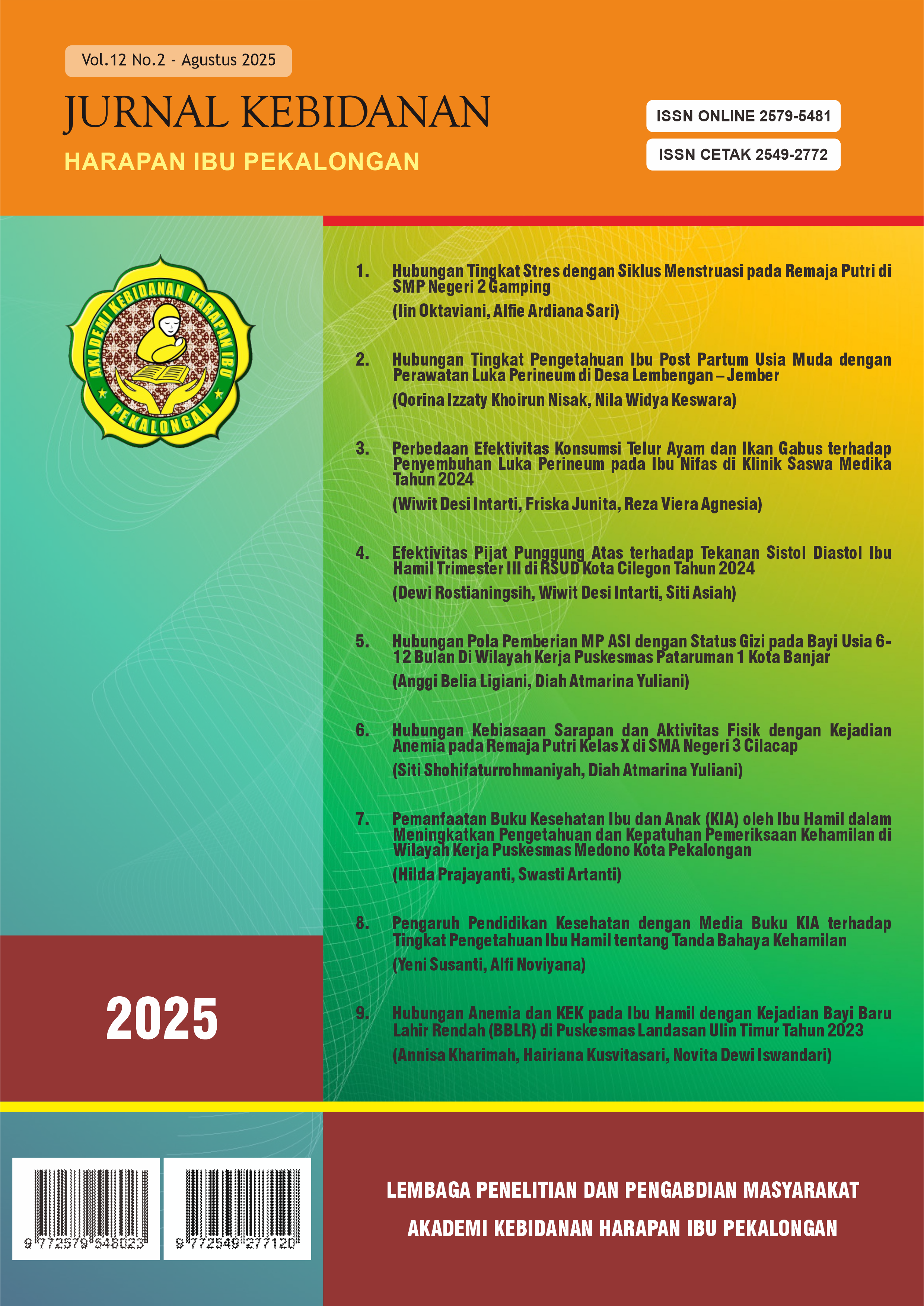
Hubungan Pola Pemberian MP ASI Dengan Status Gizi Pada Bayi Usia 6-12 Bulan Di Wilayah Kerja Puskesmas Pataruman 1 Kota Banjar
DOI:
https://doi.org/10.37402/jurbidhip.vol12.iss2.469Keywords:
complementary feeding, nutritional status, infantsAbstract
Background: Appropriate complementary feeding practices are crucial factors in determining nutritional status of infants. Inappropriate complementary feeding patterns can cause nutritional problems in infants aged 6-12 months, thus evaluation of complementary feeding practices and their relationship with infant nutritional status is necessary. Objective: To determine the relationship between complementary feeding patterns and nutritional status in infants aged 6-12 months in the working area of Pataruman 1 Primary Health Center, Banjar City. Methods: This study used a cross-sectional design with a population of toddlers receiving complementary feeding at Pataruman I Primary Health Center, Banjar City based on January-February 2025 data totaling 300 people. The research sample was determined using the sample size formula for ordinal-nominal correlative analytics with a sample size of 60 infants aged 6-12 months. Results: Most complementary feeding patterns were in the appropriate category, namely 35 infants (58.3%). Most infant nutritional status was in the good nutrition category, namely 37 infants (61.7%). The analysis results showed a significant relationship between complementary feeding patterns and nutritional status with the percentage of good nutritional status reaching 85.7%. Conclusion: There is a significant relationship between complementary feeding patterns and nutritional status in infants aged 6-12 months in the working area of Pataruman 1 Primary Health Center, Banjar City.
Downloads
Published
How to Cite
Issue
Section
License
Authors who publish with this journal agree to the following terms:
Authors retain copyright and grant the journal right of first publication with the work simultaneously licensed under a Creative Commons Attribution License that allows others to share the work with an acknowledgement of the work's authorship and initial publication in this journal.
Authors are able to enter into separate, additional contractual arrangements for the non-exclusive distribution of the journal's published version of the work (e.g., post it to an institutional repository or publish it in a book), with an acknowledgement of its initial publication in this journal.
Authors are permitted and encouraged to post their work online (e.g., in institutional repositories or on their website) prior to and during the submission process, as it can lead to productive exchanges, as well as earlier and greater citation of published work (See The Effect of Open Access).