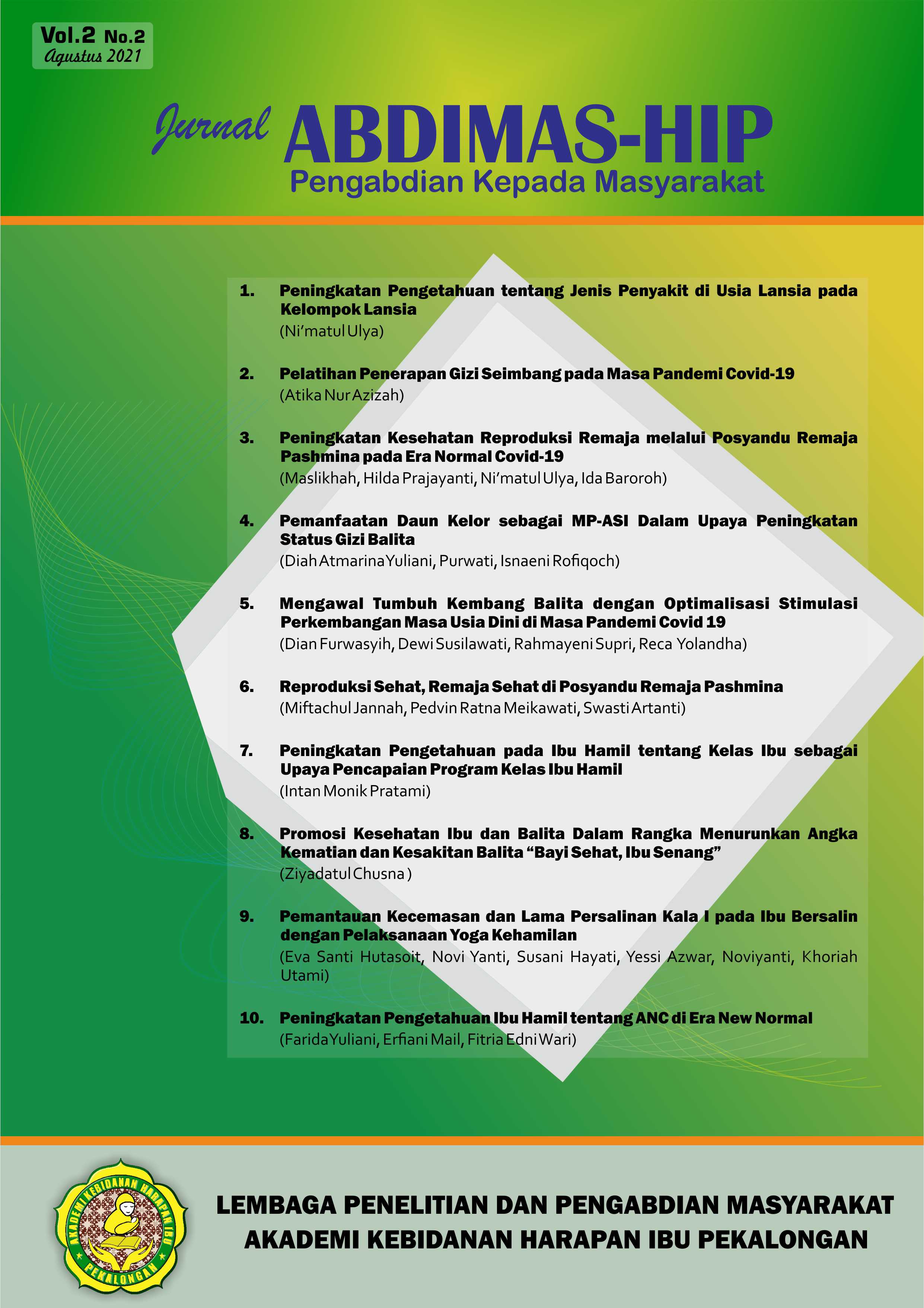
Mengawal Tumbuh Kembang Balita dengan Optimalisasi Stimulasi Perkembangan Masa Usia Dini di Masa Pandemi Covid-19
DOI:
https://doi.org/10.37402/abdimaship.vol2.iss2.148Abstract
Monitoring of growth and development is an activity to detect early growth irregularities (malnutrition or poor nutritional status, short children), developmental deviations (late speaking), and mental emotional disorders (impaired concentration and hyperactivity). The rapid growth and development in the first 1,000 days of life makes monitoring of child development very important at this age. The first 1,000 days of life are counted from the time of conception in the mother's womb until the child is 2 years old. In children aged 2 years, the height has reached half of the adult's height and the brain development has reached 80% of the adult brain. Since March 2020, Indonesia has been hit by the COVID-19 pandemic. This resulted in the temporary suspension of posyandu activities in various regions in Indonesia. Fears of a pandemic condition make parents afraid to bring toddlers to clinics and puskesmas. One of the easiest steps for mothers and caregivers to take to stimulate the growth and development of toddlers at home is baby massage. Solutions and targets The outputs offered in this activity are growth and development stimulation education, infant massage demonstrations, and assistance to mothers of toddlers for infant massage for 2x a month. The output targets are publication of articles in the journal Community Service, print media publications, and increasing community empowerment and strengthening knowledge and developing community habits in healthy behavior
Downloads
Published
Issue
Section
License
Authors who publish with this journal agree to the following terms:
-
Authors retain copyright and grant the journal right of first publication with the work simultaneously licensed under a Creative Commons Attribution 4.0 International License (CC BY 4.0) that allows others to share (copy and redistribute the material in any medium or format) and adapt (remix, transform, and build upon the material) for any purpose, even commercially, with an acknowledgement of the work's authorship and initial publication in this journal.
-
Authors are able to enter into separate, additional contractual arrangements for the non-exclusive distribution of the journal's published version of the work (e.g., post it to an institutional repository or publish it in a book), with an acknowledgement of its initial publication in this journal.
-
Authors are permitted and encouraged to post their work online (e.g., in institutional repositories or on their website) prior to and during the submission process, as it can lead to productive exchanges, as well as earlier and greater citation of published work (See The Effect of Open Access).