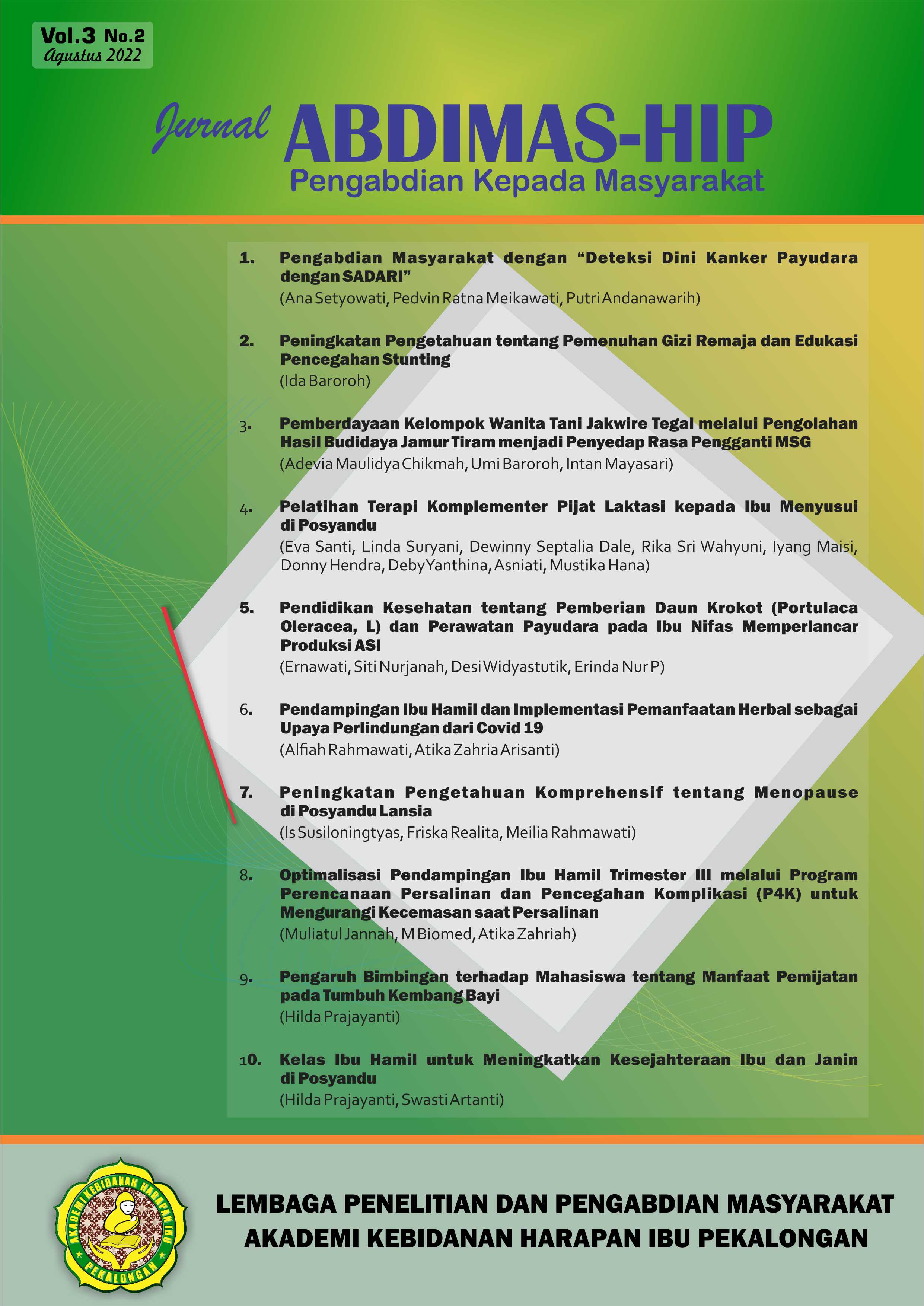
Peningkatan Pengetahuan tentang Pemenuhan Gizi Remaja dan Edukasi Pencegahan Stunting
DOI:
https://doi.org/10.37402/abdimaship.vol3.iss2.194Abstract
The problem of nutrition in Indonesia is still a serious problem. In essence, it stems from an economic situation that lacks limited knowledge about nutrition. Nutritional status is a measure of success in meeting the nutritional needs of children and the use of nutrients indicated by the child's weight and height. Nutritional needs in adolescence are very large because they are still growing. One of the main nutritional problems for adolescents in developing countries is malnutrition, which is reflected in stunting, underweight, stunted growth, and intrauterine growth retardation (IUGR) in pregnant adolescent girls. The purpose of this community service is to increase adolescent knowledge about the fulfillment of adolescent nutrition and stunting prevention education. The methods of health education carried out are (1) Socialization and Licensing, (2) Affirmation and Pre Test (3) Conducting health education regarding the fulfillment of adolescent nutrition and stunting prevention education. (4) Evaluation of the results of health education activities with Post Test. The results of this health education are expected to increase the knowledge and understanding of participants about the importance of fulfilling adolescent nutrition and stunting prevention education. The output of this activity is shown by increasing participants' knowledge about the importance of fulfilling adolescent nutrition and stunting prevention education which can be seen from the results of pre and post test questionnaires.
Downloads
Published
Issue
Section
License
Authors who publish with this journal agree to the following terms:
-
Authors retain copyright and grant the journal right of first publication with the work simultaneously licensed under a Creative Commons Attribution 4.0 International License (CC BY 4.0) that allows others to share (copy and redistribute the material in any medium or format) and adapt (remix, transform, and build upon the material) for any purpose, even commercially, with an acknowledgement of the work's authorship and initial publication in this journal.
-
Authors are able to enter into separate, additional contractual arrangements for the non-exclusive distribution of the journal's published version of the work (e.g., post it to an institutional repository or publish it in a book), with an acknowledgement of its initial publication in this journal.
-
Authors are permitted and encouraged to post their work online (e.g., in institutional repositories or on their website) prior to and during the submission process, as it can lead to productive exchanges, as well as earlier and greater citation of published work (See The Effect of Open Access).