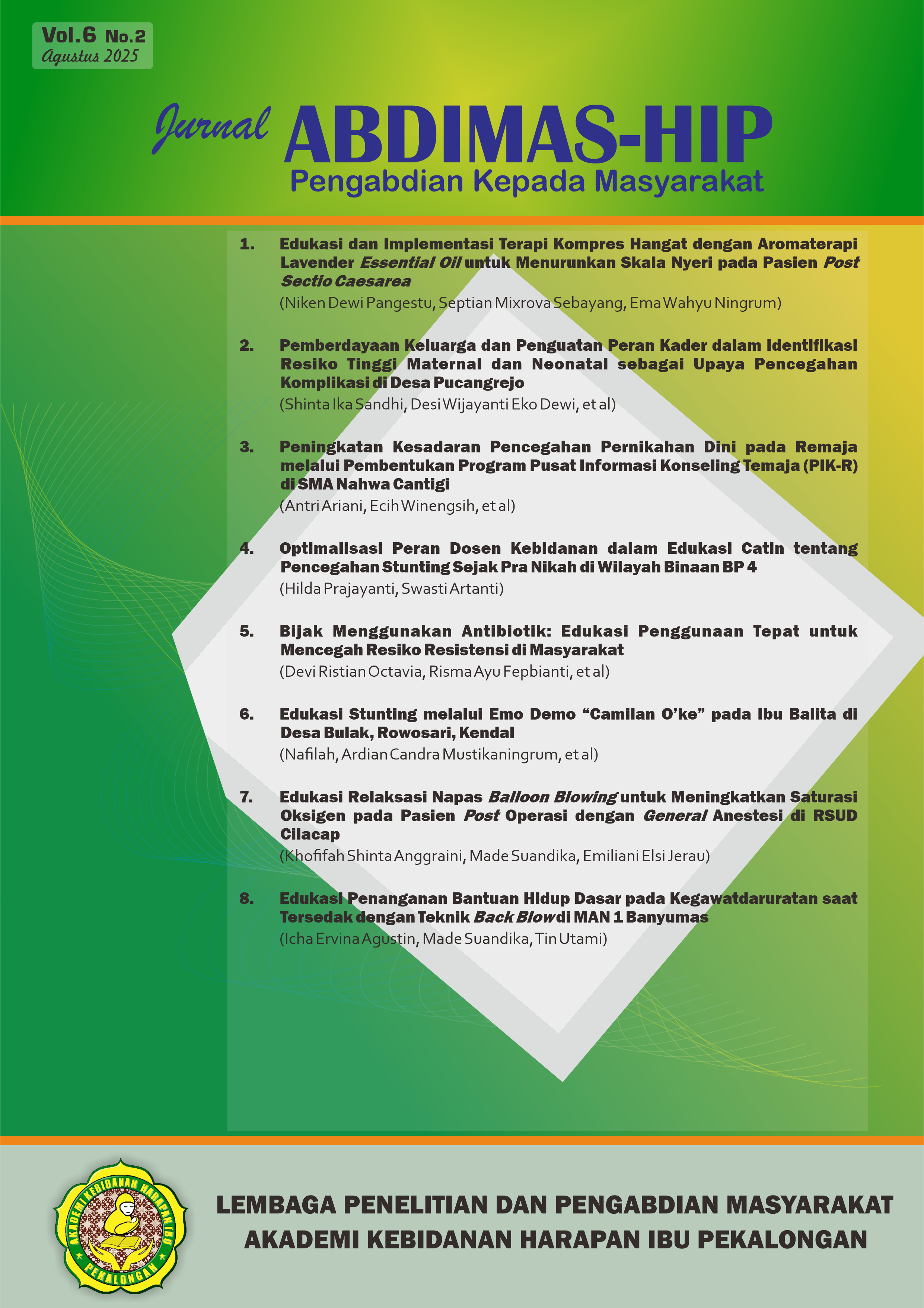
Edukasi dan Implementasi Terapi Kompres Hangat dengan Aromaterapi Lavender Essential Oil untuk Menurunkan Skala Nyeri pada Pasien Post Sectio Caesarea
DOI:
https://doi.org/10.37402/abdimaship.vol6.iss2.450Keywords:
warm compress, lavender, painAbstract
Post-cesarean section patients often experience severe pain that can hinder the recovery process and interfere with infant care. At Ajibarang Regional Public Hospital, particularly in the Nuri ward, the implementation of non-pharmacological pain management remains limited. Until now, patients have not received interventions such as warm compress therapy combined with lavender aromatherapy. This community service activity aimed to provide health education and implement interventions to improve patient knowledge and reduce pain levels after cesarean section surgery. The methods used included delivering educational materials and carrying out the intervention directly. Pocketbooks were used for education, while hot water bags and diffusers were used for therapy. The results showed that out of 30 participants, 21 (70.0%) had good knowledge before the education, increasing to 24 (80.0%) afterward. Before the intervention, 22 participants (73.3%) reported moderate pain, which decreased to mild pain in 20 participants (66.7%) after the intervention. These findings suggest that education and the application of warm compress therapy with lavender aromatherapy effectively improve knowledge and reduce pain in post-cesarean patients.
Downloads
Published
Issue
Section
License
Authors who publish with this journal agree to the following terms:
-
Authors retain copyright and grant the journal right of first publication with the work simultaneously licensed under a Creative Commons Attribution 4.0 International License (CC BY 4.0) that allows others to share (copy and redistribute the material in any medium or format) and adapt (remix, transform, and build upon the material) for any purpose, even commercially, with an acknowledgement of the work's authorship and initial publication in this journal.
-
Authors are able to enter into separate, additional contractual arrangements for the non-exclusive distribution of the journal's published version of the work (e.g., post it to an institutional repository or publish it in a book), with an acknowledgement of its initial publication in this journal.
-
Authors are permitted and encouraged to post their work online (e.g., in institutional repositories or on their website) prior to and during the submission process, as it can lead to productive exchanges, as well as earlier and greater citation of published work (See The Effect of Open Access).