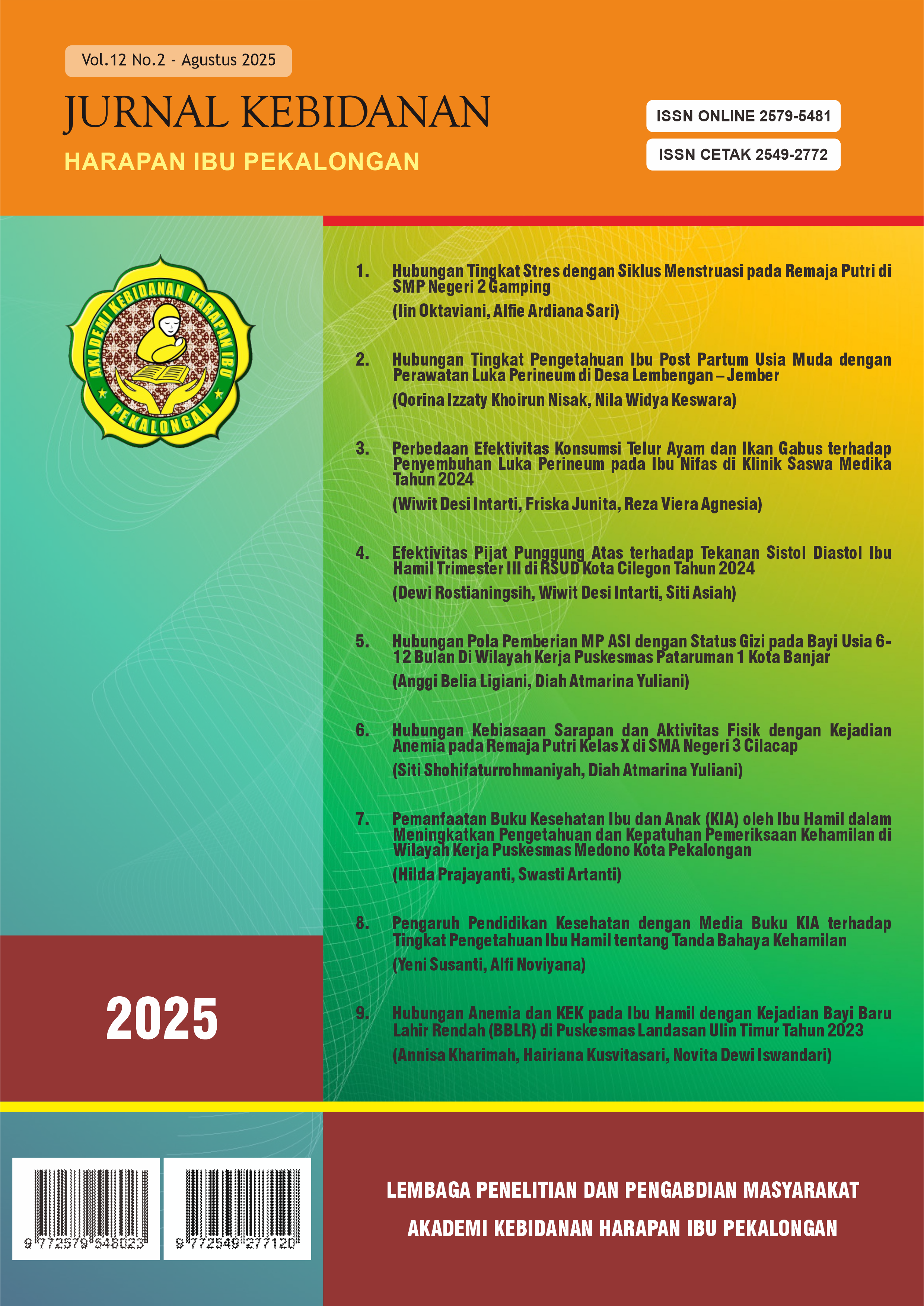
Perbedaan Efektivitas Konsumsi Telur Ayam dan Ikan Gabus terhadap Penyembuhan Luka Perineum pada Ibu Nifas di Klinik Saswa Medika Tahun 2024
DOI:
https://doi.org/10.37402/jurbidhip.vol12.iss2.395Keywords:
perineal wound, postpartum women, chicken egg, cork fish, wound healingAbstract
Perineal wounds in postpartum women can slow down the postpartum recovery process. Optimal wound care is needed to prevent infection and accelerate healing. Animal proteins such as chicken eggs and cork fish are known to have benefits in accelerating tissue regeneration. This study aims to determine the difference in the length of perineal wound healing between postpartum women who consume chicken eggs and those who consume cork fish at Saswa Medika Clinic in 2024. This study used a quasi-experimental design with a post-test only group design approach. The study sample consisted of 20 postpartum women who had perineal wounds, divided into two groups: a group that consumed chicken eggs and a group that consumed cork fish for 7 days. Wound healing was measured using the REEDA scale on days 4 and 7. Data analysis used Mann-Whitney test. The results showed that postpartum women who consumed cork fish experienced faster wound healing compared to those who consumed chicken eggs. The majority of mothers in the cork fish group had lower REEDA scores, indicating better wound condition than the chicken egg group (p < 0.05). Consumption of cork fish is more effective in accelerating perineal wound healing than chicken eggs. This study can be a reference for health workers in providing education about nutritional intake that supports the recovery of postpartum women.
Downloads
Published
How to Cite
Issue
Section
License
Authors who publish with this journal agree to the following terms:
-
Authors retain copyright and grant the journal right of first publication with the work simultaneously licensed under a Creative Commons Attribution 4.0 International License (CC BY 4.0) that allows others to share (copy and redistribute the material in any medium or format) and adapt (remix, transform, and build upon the material) for any purpose, even commercially, with an acknowledgement of the work's authorship and initial publication in this journal.
-
Authors are able to enter into separate, additional contractual arrangements for the non-exclusive distribution of the journal's published version of the work (e.g., post it to an institutional repository or publish it in a book), with an acknowledgement of its initial publication in this journal.
-
Authors are permitted and encouraged to post their work online (e.g., in institutional repositories or on their website) prior to and during the submission process, as it can lead to productive exchanges, as well as earlier and greater citation of published work (See The Effect of Open Access).