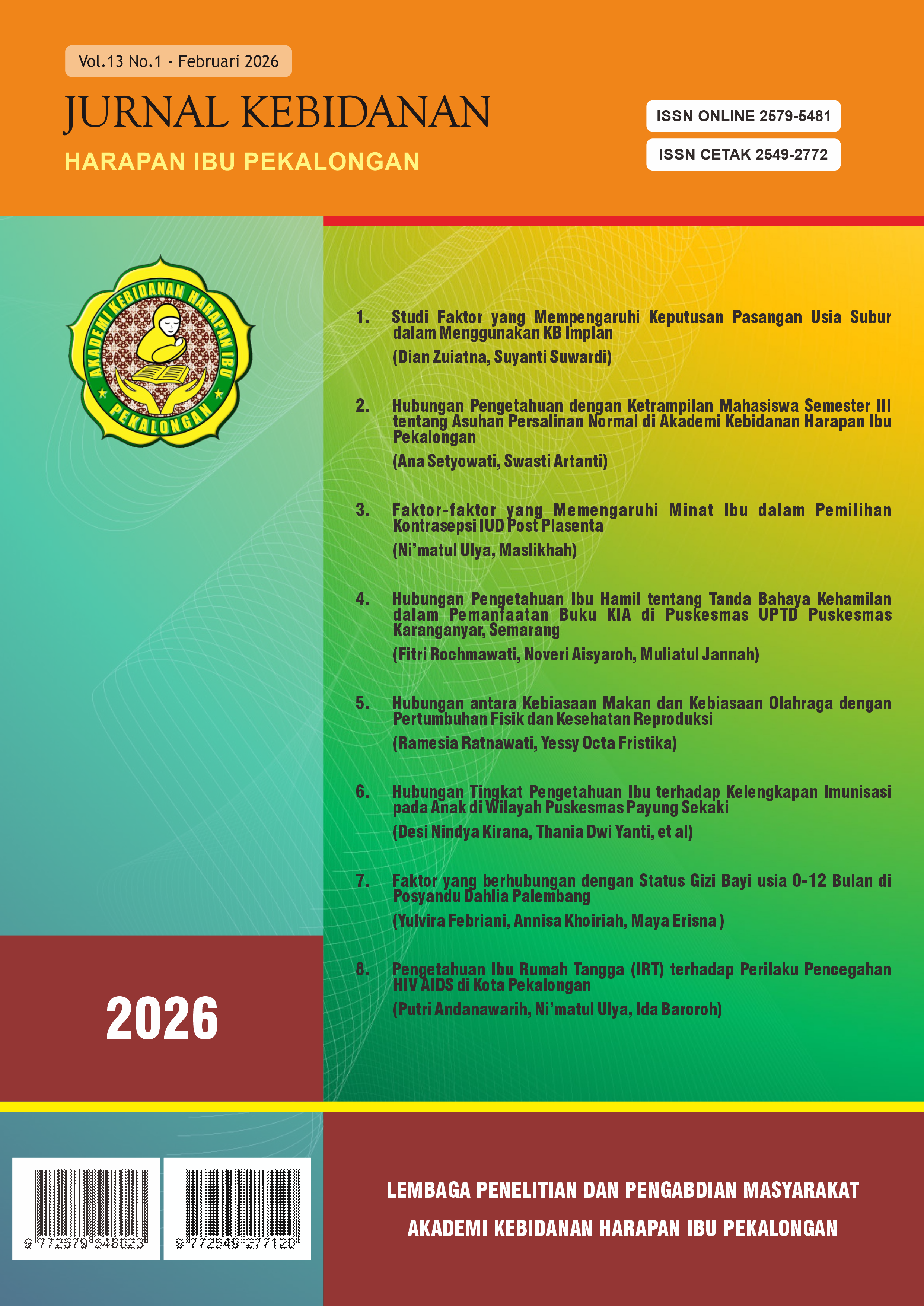
Faktor yang berhubungan dengan Status Gizi Bayi Usia 0–12 Bulan di Posyandu Dahlia Palembang
DOI:
https://doi.org/10.37402/jurbidhip.vol13.iss1.502Keywords:
infant nutritional status, family factors, exclusive breastfeeding, integrated health postAbstract
Infant nutritional problems remain a public health concern as they affect child growth and development. Infant nutritional status is influenced by various factors related to infant characteristics and family conditions. This study aimed to identify factors associated with the nutritional status of infants aged 0–12 months at Dahlia Integrated Health Post, Palembang. This quantitative study employed a cross-sectional design. The population included all infants aged 0–12 months, with a total sampling technique resulting in 30 infants. Independent variables included infant age, sex, birth weight, exclusive breastfeeding, maternal education, maternal occupation, and parental income. Nutritional status was assessed using weight-for-age, length-for-age, and weight-for-length indicators. Data were analyzed using Chi-Square and Fisher’s Exact tests. The results showed that most infants had normal nutritional status based on all anthropometric indicators. Bivariate analysis indicated no significant association between most infant and family factors and nutritional status. However, infant age was significantly associated with nutritional status based on length-for-age (p < 0.05). These findings highlight the importance of early monitoring of linear growth in infants, particularly during the complementary feeding transition period.
Downloads
Published
How to Cite
Issue
Section
License
Authors who publish with this journal agree to the following terms:
-
Authors retain copyright and grant the journal right of first publication with the work simultaneously licensed under a Creative Commons Attribution 4.0 International License (CC BY 4.0) that allows others to share (copy and redistribute the material in any medium or format) and adapt (remix, transform, and build upon the material) for any purpose, even commercially, with an acknowledgement of the work's authorship and initial publication in this journal.
-
Authors are able to enter into separate, additional contractual arrangements for the non-exclusive distribution of the journal's published version of the work (e.g., post it to an institutional repository or publish it in a book), with an acknowledgement of its initial publication in this journal.
-
Authors are permitted and encouraged to post their work online (e.g., in institutional repositories or on their website) prior to and during the submission process, as it can lead to productive exchanges, as well as earlier and greater citation of published work (See The Effect of Open Access).