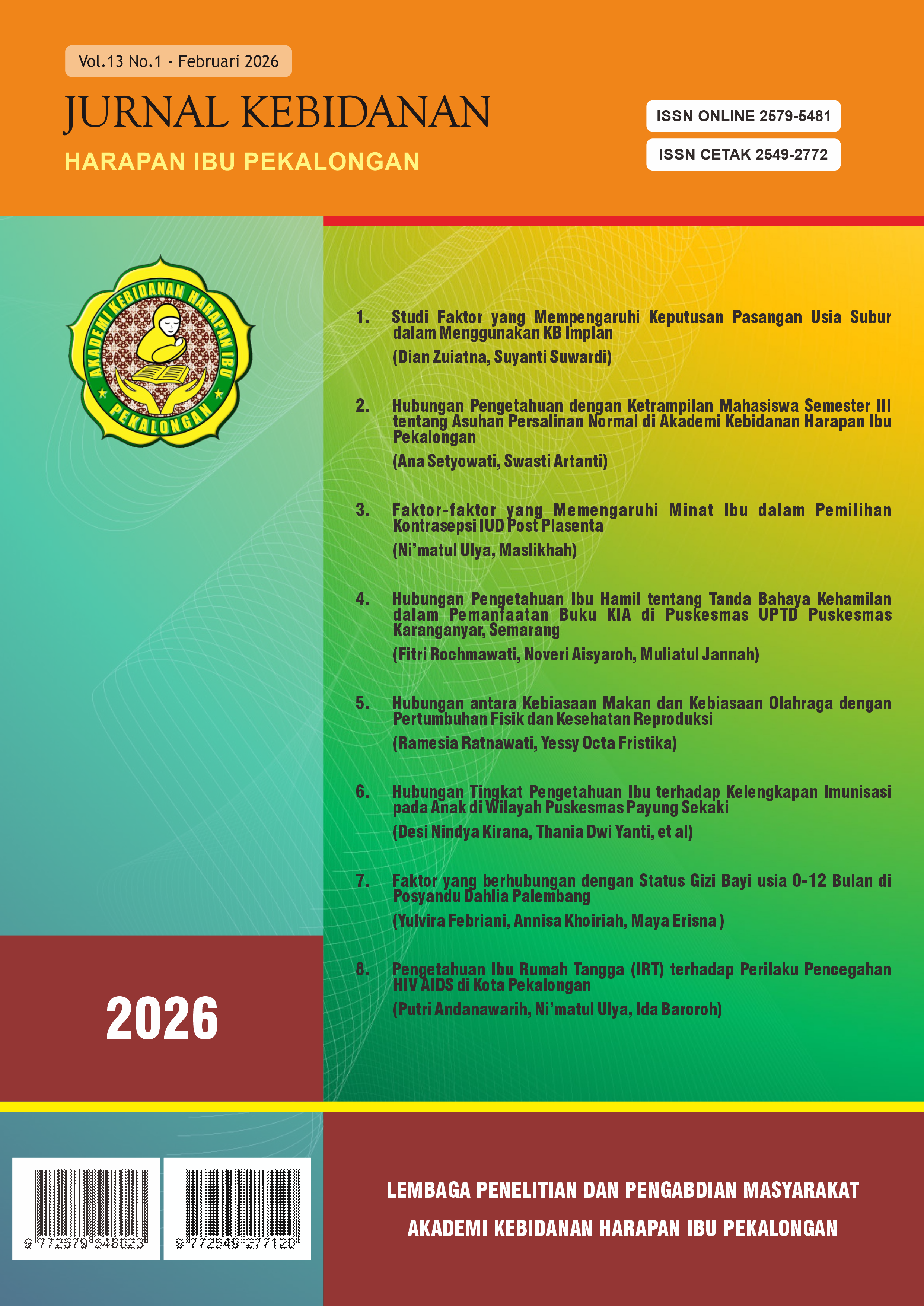
Studi Faktor yang Mempengaruhi Keputusan Pasangan Usia Subur dalam Menggunakan KB Implan
DOI:
https://doi.org/10.37402/jurbidhip.vol13.iss1.503Keywords:
implant contraceptio, age, knowledge, parityAbstract
According to Government Regulation of the Republic of Indonesia Number 87 of 2014 concerning population development and family development, family planning and family information systems. The family planning (KB) program is a program that seeks to regulate childbearing, spacing and ideal age of birth, manage pregnancy, through the promotion of protection and assistance in accordance with reproductive rights to create a quality family. Many couples of childbearing age still have limited knowledge about implant contraception, including how it works, benefits, side effects, and its safety as a long-term contraceptive method. This results in low interest and trust in the use of implant contraception. The purpose of this study is to determine the factors that influence the decision of fertile couples in using implant contraception. This type of research uses a survey method with a cross-sectional approach, namely where measurements or observations are carried out simultaneously on the independent and dependent variable data. The population is all PUS mothers who use implant contraception in Bandar Khalifah Village, namely 45 people by total sampling. Data analysis uses the chi-square test and multivariate with logistic regression tests. Based on the results of the logistic regression test, this study shows that there is an influence of knowledge on implant contraception in Bandar Khalifah Village, Percut Sei Tuan District, Deli Serdang Regency with an Exp (B) value of 103.964. The conclusion of this study is that the variable of knowledge is the most influential factor on the use of contraceptive implants in PUS in Bandar Khalifah Village. Therefore, health workers should provide counseling and promotion to the community, especially in PUS, about contraceptive implants so that the community's knowledge and attitudes become better. The results of this study can be a basis for health workers, especially midwives and family planning officers, in developing more effective and targeted educational, counseling, and approach strategies to increase the use of contraceptive implants.
Downloads
Published
How to Cite
Issue
Section
License
Authors who publish with this journal agree to the following terms:
-
Authors retain copyright and grant the journal right of first publication with the work simultaneously licensed under a Creative Commons Attribution 4.0 International License (CC BY 4.0) that allows others to share (copy and redistribute the material in any medium or format) and adapt (remix, transform, and build upon the material) for any purpose, even commercially, with an acknowledgement of the work's authorship and initial publication in this journal.
-
Authors are able to enter into separate, additional contractual arrangements for the non-exclusive distribution of the journal's published version of the work (e.g., post it to an institutional repository or publish it in a book), with an acknowledgement of its initial publication in this journal.
-
Authors are permitted and encouraged to post their work online (e.g., in institutional repositories or on their website) prior to and during the submission process, as it can lead to productive exchanges, as well as earlier and greater citation of published work (See The Effect of Open Access).