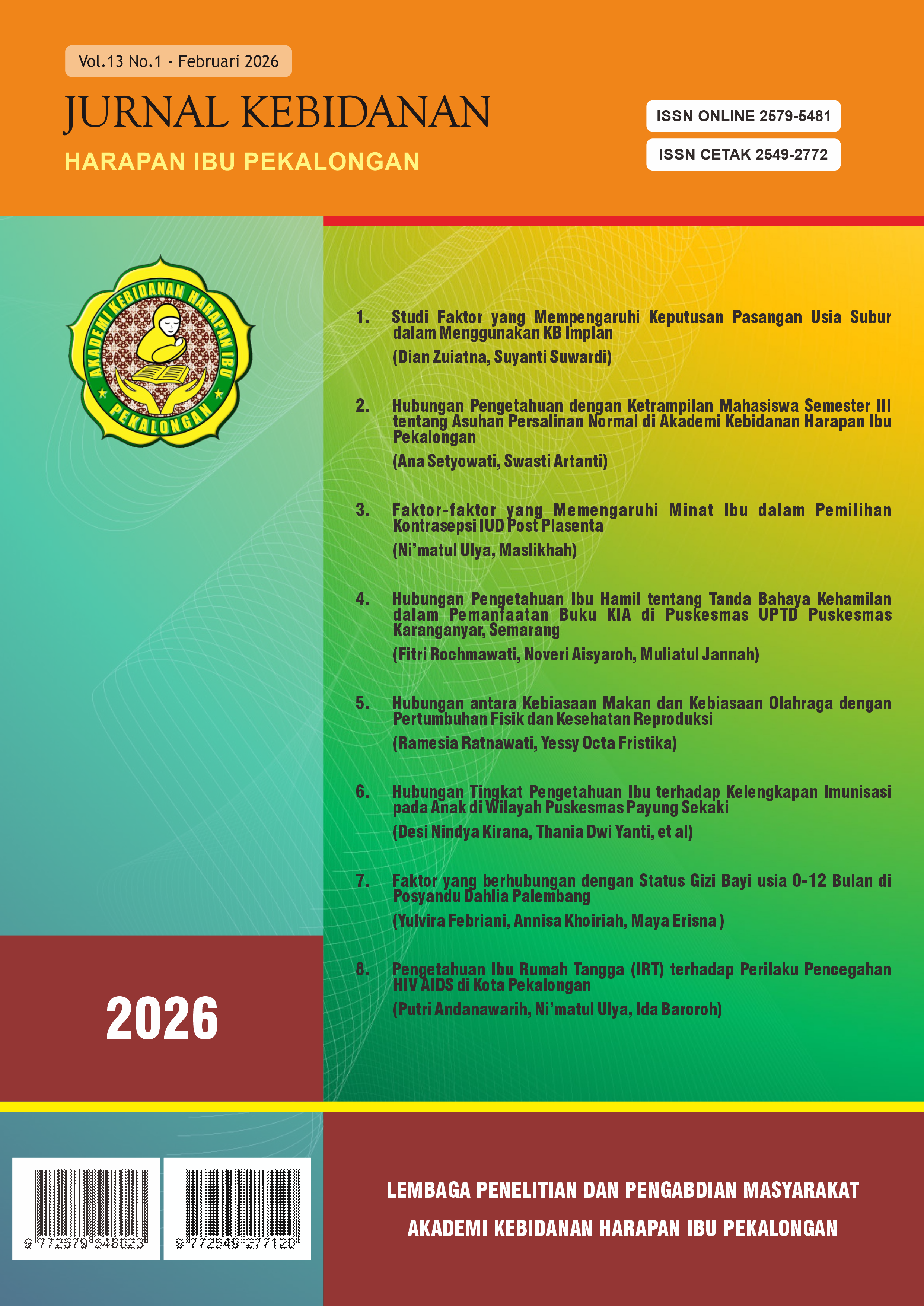
Hubungan Tingkat Pengetahuan Ibu terhadap Kelengkapan Imunisasi pada Anak di Wilayah Puskesmas Payung Sekaki
DOI:
https://doi.org/10.37402/jurbidhip.vol13.iss1.516Keywords:
mother’s knowledge, basic immunization, children, public health centerAbstract
Immunization is an effective preventive measure that protects children from various infectious diseases that can be prevented by immunization. However, the completeness of immunization in children remains a public health problem in several areas, including the working area of the Payung Sekaki Community Health Center. A factor that influences the completeness of immunization is the level of maternal knowledge. This study aims to determine the relationship between the level of maternal knowledge and the completeness of immunization in children in the Payung Sekaki Community Health Center area. This study used a quantitative method with a cross-sectional design. The number of respondents was 15 mothers with children aged 12–23 months, using a purposive sampling technique. Data were collected through questionnaires to measure the level of maternal knowledge and KIA book records to determine the status of completeness of children's immunization. Data analysis was carried out univariate and bivariate using the Chi-Square test. The study showed that most mothers had a good level of knowledge (46.7%) and most children had received complete basic immunization (60.0%). The results of the Chi-Square test showed a significant relationship between the level of maternal knowledge and the completeness of children's immunization with a p value of 0.041 (p < 0.05). The conclusion of this study is that there is a significant relationship between maternal knowledge and the completeness of immunizations in children in the Payung Sekaki Community Health Center area. Therefore, improving health education for mothers is necessary to increase the coverage of complete basic immunizations.
Downloads
Published
How to Cite
Issue
Section
License
Authors who publish with this journal agree to the following terms:
-
Authors retain copyright and grant the journal right of first publication with the work simultaneously licensed under a Creative Commons Attribution 4.0 International License (CC BY 4.0) that allows others to share (copy and redistribute the material in any medium or format) and adapt (remix, transform, and build upon the material) for any purpose, even commercially, with an acknowledgement of the work's authorship and initial publication in this journal.
-
Authors are able to enter into separate, additional contractual arrangements for the non-exclusive distribution of the journal's published version of the work (e.g., post it to an institutional repository or publish it in a book), with an acknowledgement of its initial publication in this journal.
-
Authors are permitted and encouraged to post their work online (e.g., in institutional repositories or on their website) prior to and during the submission process, as it can lead to productive exchanges, as well as earlier and greater citation of published work (See The Effect of Open Access).