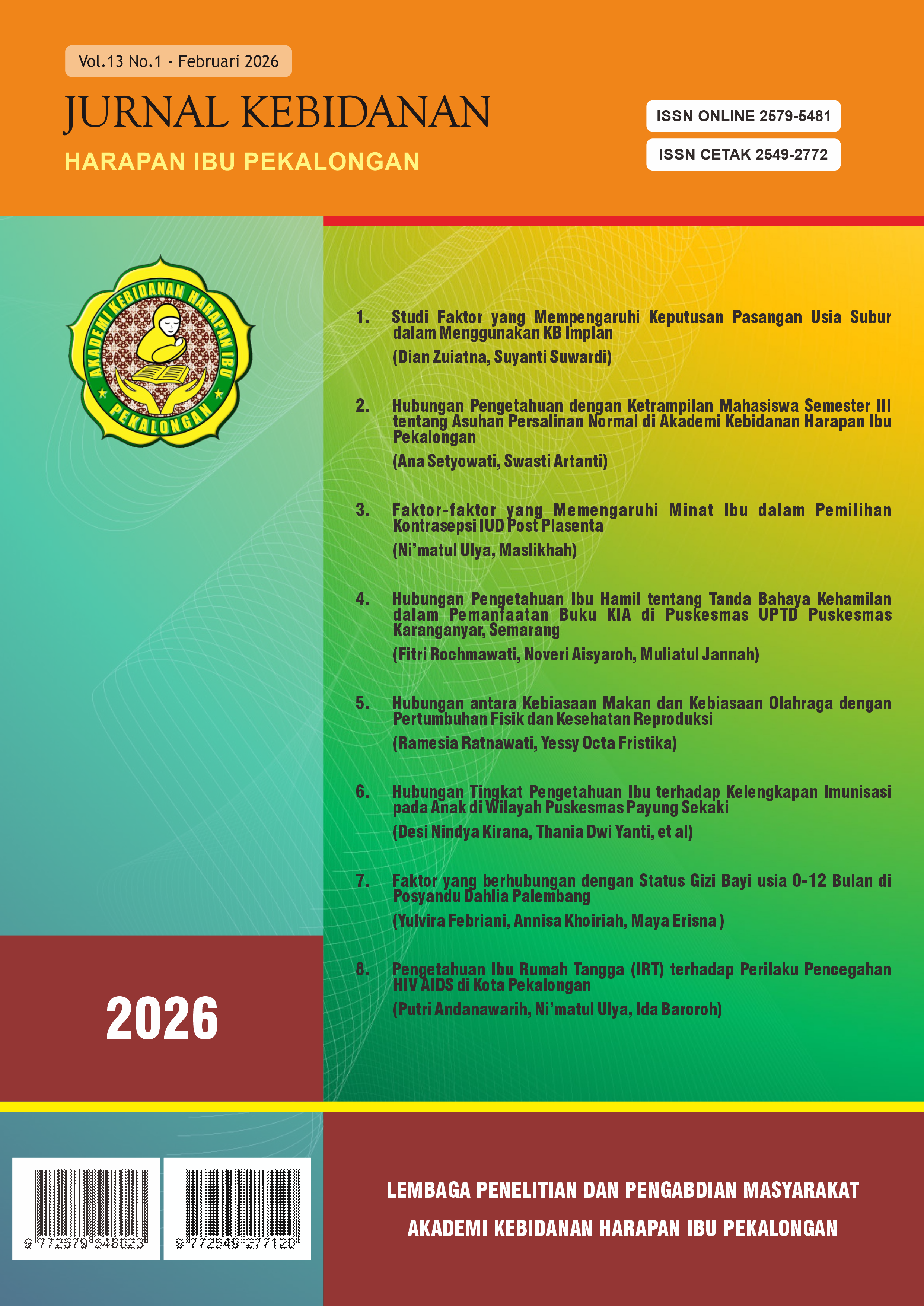
Pengetahuan Ibu Rumah Tangga (IRT) terhadap Perilaku Pencegahan HIV AIDS di Kota Pekalongan
DOI:
https://doi.org/10.37402/jurbidhip.vol13.iss1.518Keywords:
knowledge, housewives, HIV AIDS preventionAbstract
HIV/AIDS is an infectious disease with an increasing number of sufferers every year. Efforts made Voluntary Counseling and Testing (VCT) which is a form of counseling aimed at preventing HIV transmission, providing moral support, information, and other support to PLWHA, their families and their environment. The number of HIV cases in Indonesia in 2014 was 22,869 cases, with the most sufferers being housewives reaching 6,539 cases. Housewives exposed to HIV-AIDS are far more numerous than truck drivers, commercial sex workers or workers The purpose of this study was to determine the Knowledge of Housewives (IRT) Regarding HIV AIDS Prevention Behavior in Pekalongan City. This study is a descriptive study with a cross-sectional research design and uses the chi-square statistical test. The results obtained a p value of 0.534 (> 0.05) which means there is no relationship between housewives' knowledge and HIV/AIDS prevention behavior. It is hoped that housewives can continue to increase their knowledge about HIV AIDS prevention and encourage preventive behavior against infectious diseases, especially HIV AIDS
Downloads
Published
How to Cite
Issue
Section
License
Authors who publish with this journal agree to the following terms:
-
Authors retain copyright and grant the journal right of first publication with the work simultaneously licensed under a Creative Commons Attribution 4.0 International License (CC BY 4.0) that allows others to share (copy and redistribute the material in any medium or format) and adapt (remix, transform, and build upon the material) for any purpose, even commercially, with an acknowledgement of the work's authorship and initial publication in this journal.
-
Authors are able to enter into separate, additional contractual arrangements for the non-exclusive distribution of the journal's published version of the work (e.g., post it to an institutional repository or publish it in a book), with an acknowledgement of its initial publication in this journal.
-
Authors are permitted and encouraged to post their work online (e.g., in institutional repositories or on their website) prior to and during the submission process, as it can lead to productive exchanges, as well as earlier and greater citation of published work (See The Effect of Open Access).